Why Meditation with Eyes Closed Still Lets Light Through
Most meditation instructions ignore lighting entirely, which is a small but real oversight. Even with your eyes closed, light still reaches the visual system – eyelids filter light rather than block it completely. This fact has a measurable effect on how easy or difficult focused attention feels. Meditation with eyes closed in bright light is genuinely different from meditation with eyes closed in the dark, and choosing between them deliberately gives you a useful training lever.
Why Light Makes Focus Easier
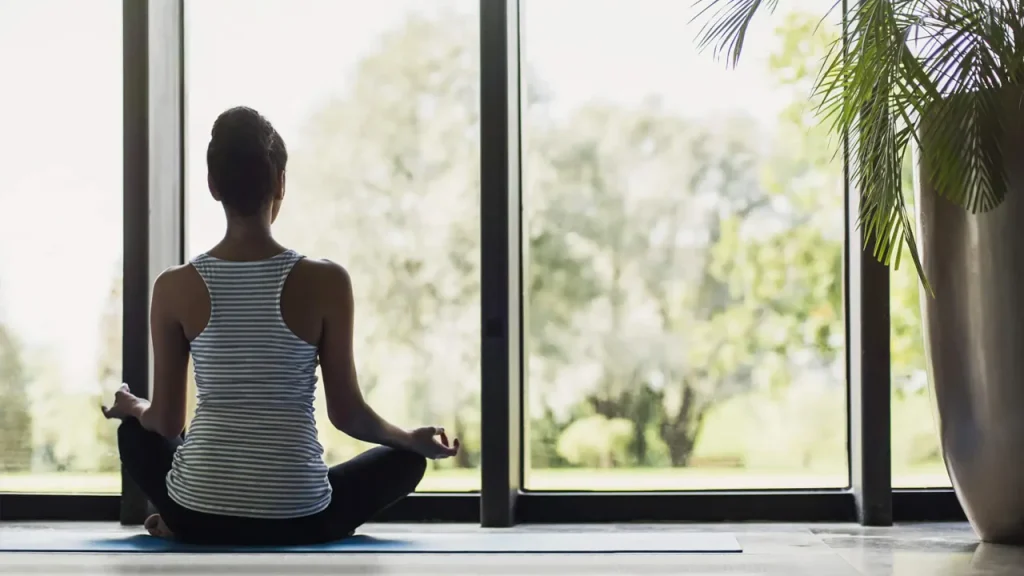
When light filters through closed eyelids, the visual cortex receives sensory input. This input keeps the cortex active rather than letting it slip into the idling state that produces high alpha. For focused-attention protocols, that residual activity is helpful it gives attention something to engage with, and the alpha-suppression target is easier to hit. Many beginners find that practising near a bright window or outside in daylight makes the first weeks of CEVAM measurably easier than practising in a dark room would.
Darkness Increases the Challenge
In a dark room, or when wearing a sleep mask, much less visual input reaches the brain. The visual cortex is more likely to slip into idle, which increases baseline alpha and makes focused attention more demanding. You have to actively engage perception without much sensory support. This is harder, but it is also useful training once your foundation is solid.
Using Brightness Strategically During Meditation with Eyes Closed
The practical pattern is to match brightness to your current training state. In the early weeks, or on days when you are tired and the focus protocol feels hopeless, choose a bright environment. The residual input gives the visual cortex something to hold onto and reduces the demand on attention itself. Over time, as your baseline focus improves, you can experiment with progressively dimmer conditions to challenge the same circuit more deeply.
How This Interacts With the Relaxation Protocol
For relaxation training, the calculus reverses. Higher alpha is the target, so reducing sensory input dim room, sleep mask, evening light actually supports the protocol. The same darkness that makes focus harder makes relaxation easier. Most practitioners do their evening relaxation sessions in low light and their morning focus sessions in a brighter environment, often without consciously connecting the choice to the underlying neuroscience.
Other Sensory Inputs Behave Similarly
Light is the clearest example, but the same logic applies to other inputs. Mild background sound soft natural noise, gentle white noise gives auditory cortex a small amount of input and can make focus protocols easier than total silence. Body temperature also matters: a slightly cool room supports alertness and focus; a warmer room supports relaxation. None of these are large effects, but they add up across a month of practice.
How Attune Reveals the Effect
Session analytics in Attune make the lighting effect visible. Run a focus session in bright daylight one morning, then run an otherwise identical session in a dim room the next morning, and compare the average alpha and catch rate. The difference is usually obvious within a single pair of sessions.
Common Mistakes
Two common errors. First, treating darkness as universally more meditative. There is a cultural association between meditation and dim rooms, but neurologically this works against focus training. Use darkness intentionally for relaxation, not by default for everything. Second, failing to use lighting as a variable to adjust difficulty. Many beginners struggle through dark-room focus sessions, conclude they are bad at meditating, and quit when a brighter environment would have made the same practice work.
When to Use Darkness Deliberately
Once your focus practice has stabilised say, after two or three months of consistent training you can use darker conditions as a challenge. The reduced sensory input forces the visual cortex to engage from a more idle baseline, which trains a stronger version of the same skill. This is similar to training in different weights at the gym: heavier loads are useful once the foundation is built, but starting there is not productive
The Takeaway
Light is not a distraction in CEVAM it is a training variable. Use brightness to support focus during meditation with eyes closed, and darkness to support relaxation or to challenge an established focus practice. Adjust the environment to your current goal and skill level.
What the First Month Tends to Look Like
When meditation with eyes closed becomes a daily practice, the arc tends to follow a predictable pattern. Week one is almost always busier than expected. The mind is loud, the body is unfamiliar with stillness, and progress feels invisible. Most people interpret this as failure. It is not. It is the brain meeting the practice for the first time, which is meant to feel busy and a little uncomfortable.
Week two often brings a small frustration plateau. The novelty has worn off, the obvious early gains have already happened, and the practice starts to feel like work. This is the most common drop-out window. Push through. The underlying neural systems are consolidating, even when the felt experience says otherwise.
Week three is usually where things begin to repay themselves. The catches happen faster. The internal narration that used to fill every session quiets a little. By the end of the month, most practitioners describe the practice as easier in a way that is hard to explain the same session that felt effortful in week one now feels almost ordinary.
If you keep going past the first month, the gains continue but they look different. Less about visible session quality, more about carry-over into daily life small moments of pause before reacting, slightly cleaner attention during work, a marginally calmer presence in difficult conversations. The skill built on the cushion shows up off the cushion, which is the point.
With Attune you can stop guessing and start measuring. Try Attune today or read more on the Attune FAQ.
Frequently Asked Questions
Is meditation with eyes closed better in light or in the dark?
For focused attention, especially when learning, light is usually better. The residual visual input keeps the visual cortex active and makes alpha suppression easier. For relaxation training, darkness is generally more useful because it supports the alpha rise the protocol rewards.
Should I use a sleep mask during meditation?
Only deliberately. A sleep mask increases the challenge of focus protocols by removing visual input. Use it as a difficulty variable once your practice is well-established, and avoid it in early weeks when the baseline is harder to keep stable.
Does it matter what colour the light is?
Not strongly, but warmer light tends to be slightly more relaxing and cooler light slightly more alerting consistent with circadian-rhythm effects on arousal. The intensity matters much more than the colour temperature.