Why Mindful Listening Begins on the Cushion
The focused attention you train during meditation does not belong only on the cushion. The same skill sustaining engagement with what is actually happening, without narrative overlay transforms ordinary experiences once you start carrying it into the rest of the day. Music is one of the most rewarding places to practise this. Mindful listening turns a passive background activity into something close to meditation in its own right.

How Most People Listen
Most music listening is accompanied by thoughts: comparisons (this album is better than their last one), memories (this song reminds me of), evaluations (the production sounds thin), mental commentary (I should send this to a friend). None of this is wrong responding to music with thought is part of how meaning is made but it is not the same as listening. The mental layer pulls attention away from the actual sound.
Mindful Listening: Sound as the Anchor
Mindful listening replaces the thinking-about layer with direct attention to the sound itself. Tone. Rhythm. Texture. The space between notes. The change in dynamics across a phrase. The instruction is the same as in CEVAM, just with sound instead of the visual field keep attention on the perception, return when you drift. The practice is simple. The experience is often striking.
Many people notice that music feels noticeably more vivid when listened to this way. Familiar songs reveal details that were always present but had been filtered out by the narrative mind. The emotional dimension also intensifies not because the music has changed, but because more of your nervous system is actually meeting it.
How to Practise Mindful Listening in Three Steps
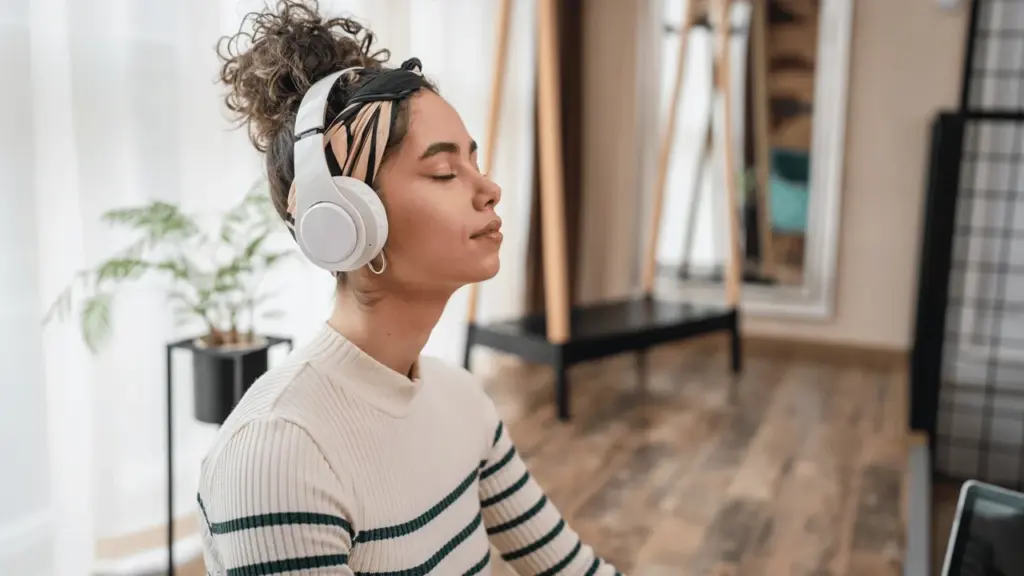
First, choose a piece you are willing to give five to ten minutes of full attention. Anything counts orchestral, electronic, a single song you know well. Second, sit, close your eyes, and place attention directly on the sound. Resist the urge to analyse, compare, or narrate. Third, when the mind drifts into thought, gently return to the sound as the anchor. The catch-and-return loop is identical to the one in seated meditation the only difference is the object of focus.
Stillness Inside, Movement Outside
One of the more surprising features of mindful listening is the combination of inner stillness with outer movement. The mind becomes quiet while the music continues to move and change. The phrase that often emerges in practitioner reports is “present without commenting.” This combination quiet attention with rich incoming sensation is a hallmark of meditative awareness in general, but it is unusually accessible through music because music holds attention so reliably.
Beyond Music: The Same Skill in Other Domains
The same principle applies to other temporal experiences. Art can be enjoyed by resting attention on the artwork without interpretation. Nature wind in trees, a moving body of water, the patterns of light on a wall can become meditative when attention stays with perception. Even routine activities become richer: walking, cooking, eating. The skill trained in seated meditation generalises into anything you do, once you remember to apply it.
Why Focused Attention Makes the Difference
Practitioners who have spent time with Attune or any focused-attention training tend to find mindful listening relatively easy because the underlying skill is the same. The catch-and-return loop transfers cleanly. Without that training, the mind tends to slide into narrative within thirty seconds and the practice becomes more of an intention than an experience. Sitting practice strengthens the skill; everyday application brings it into life.
What Goes Wrong
Two common failure modes. First, choosing music that triggers strong nostalgia the memory layer overrides the perception layer and the session becomes mental time travel. Pick something less personal for early practice. Second, treating mindful listening as performance, where you try to feel something intense or arrive at a particular state. Drop the goal. Just listen. The richer experience tends to arrive by itself when you stop trying to engineer it.
How to Start a Daily Mindful Listening Practice
Five minutes a day for two weeks is enough to install the habit. Pick one piece of music short, preferably instrumental and listen to it daily with full attention. Notice how the experience changes across the repetitions. By the end of week one most practitioners report hearing details they had previously missed. By the end of week two the listening starts to feel different from ordinary listening quieter, more present, more saturated with the music itself. From there, you can extend to longer pieces and more varied material.
The Takeaway
Meditation is not about withdrawing from experience. It is about meeting it fully, without mental noise. Mindful listening is one of the most accessible ways to apply the skill outside the cushion and one of the most rewarding.
What the First Month Tends to Look Like
When mindful listening becomes a daily practice, the arc tends to follow a predictable pattern. Week one is almost always busier than expected. The mind is loud, the body is unfamiliar with stillness, and progress feels invisible. Most people interpret this as failure. It is not. It is the brain meeting the practice for the first time, which is meant to feel busy and a little uncomfortable.
Week two often brings a small frustration plateau. The novelty has worn off, the obvious early gains have already happened, and the practice starts to feel like work. This is the most common drop-out window. Push through. The underlying neural systems are consolidating, even when the felt experience says otherwise.
Week three is usually where things begin to repay themselves. The catches happen faster. The internal narration that used to fill every session quiets a little. By the end of the month, most practitioners describe the practice as easier in a way that is hard to explain the same session that felt effortful in week one now feels almost ordinary.
If you keep going past the first month, the gains continue but they look different. Less about visible session quality, more about carry-over into daily life small moments of pause before reacting, slightly cleaner attention during work, a marginally calmer presence in difficult conversations. The skill built on the cushion shows up off the cushion, which is the point.
With Attune you can stop guessing and start measuring. Try Attune today or read more on the Attune FAQ.
Frequently Asked Questions
Do I need meditation experience to practise mindful listening?
No, but it helps. Without some attentional foundation, the mind drifts into thought within seconds and the practice becomes intermittent. Even a couple of weeks of seated practice makes mindful listening dramatically more workable.
What music works best for mindful listening?
Anything that holds your attention and does not strongly trigger memory or narrative. Instrumental music orchestral, ambient, acoustic tends to be easier than music with lyrics, because lyrics actively recruit the narrative mind. Once the skill is solid, any music works.
How long should a mindful listening session be?
Five to ten minutes is plenty to start. The point is the quality of attention, not the length. A single song with full attention is more useful than an entire album with split attention.