Why Closed Eye Visuals Meditation Reveals How Your Brain Is Wired
Practitioners who spend time in inner visual field meditation often report seeing the same handful of geometric patterns tunnels, spirals, lattices, cobweb-like networks of lines. These shapes have a name. Heinrich Klüver, working in the 1920s, called them form constants, and they are central to a quietly fascinating corner of neuroscience that closed eye visuals meditation can illuminate. The patterns are not random, and they are not mystical. They are evidence of how your visual cortex is built.
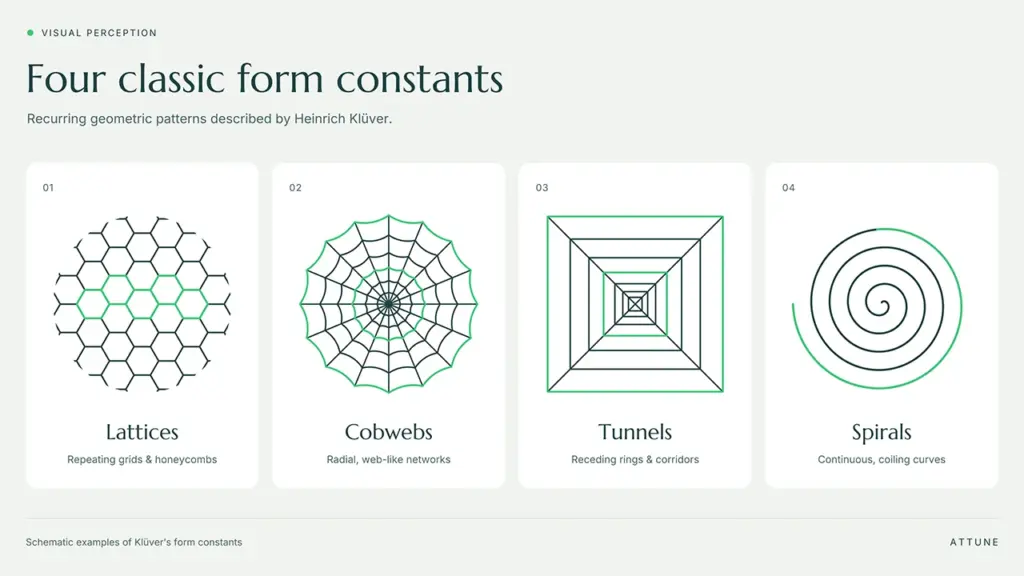
The Four Classic Form Constants
Klüver organised simple geometric hallucinations into four families. Tunnels and funnels concentric rings or a sense of moving through a tube that narrows or widens. Spirals coiling shapes that twist inward or outward, often rotating or pulsing. Lattices and honeycombs grids, hexagons, checkerboards, or interlocking triangles that cover the whole visual field. Cobwebs and radial lines patterns made of lines radiating outward with cross-links. People report versions of these after psychedelics, during migraines, in hypnagogic states, and sometimes simply when lying in the dark long enough.
Why These Patterns Keep Coming Back
Current theories suggest form constants reflect the wiring of the visual cortex rather than anything mystical in the patterns themselves. The primary visual cortex (V1) is organised like a sheet of cells tuned to orientations and positions in the visual field. When this network becomes unstable because of drugs, flicker, fatigue, or strong internal focus waves of activity spread across it. Mathematical models show that those waves naturally map onto tunnels, spirals, lattices, and cobwebs when projected back into visual space. In other words, your brain tends to hallucinate the shapes that its own wiring most easily produces.
Closed Eye Visuals Meditation vs Active Imagery
It is helpful to distinguish form constants from deliberate mental imagery. Form constants usually arise spontaneously faint outlines, flicker, moving textures that appear even when you are not trying to picture anything. Imagery is what happens when you actively construct scenes or objects. The classic CEVAM instruction applies to closed eye visuals meditation too: you are looking at these emerging patterns, not creating them. The moment you start drawing with your mind, attention drifts into storytelling rather than staying with raw perception.
Working With Form Constants in Practice
When these shapes appear during closed-eye practice, you can use them as anchors rather than distractions. Three simple moves help. First, notice which family shows up most often for you tunnel, spiral, lattice, or cobweb. Many practitioners have a personal default that recurs across sessions. Second, gently stabilise your attention on the overall pattern, not on chasing details. Trying to track a single moving element pulls the mind into narrative pursuit. Third, treat the pattern as background evidence that your visual cortex is active and engaged, while your main task remains to stay present with the act of looking.
Do Not Decode the Content
It is tempting to interpret form constants symbolically to read meaning into a particular spiral or to wonder why tunnels appear at certain times. Resist this. The patterns are structured neural activity, not messages. Interpreting them turns the practice into divination and the attention into commentary. The useful move is to relate to them as you would relate to clouds: structured, sometimes beautiful, not personally addressed to you.
Why Form Constants Often Appear With Attune
Practitioners using Attune sometimes report a noticeable increase in form constants once their attentional stability improves. This is not a sign of anything unusual. Strong, sustained engagement with the inner visual field tends to push the visual cortex into the kind of organised instability that produces these patterns. Their appearance is a quiet confirmation that closed eye visuals meditation is working at the level of cortical activity, not just at the level of felt experience.
When Patterns Become Distracting
Occasionally form constants become strong enough to pull attention away from the underlying practice. Two responses help. First, soften the gaze of attention broaden it from any single element to the whole field, and the patterns tend to recede. Second, do not fight them. Trying to make them disappear creates the same kind of effort that destabilises focus in general. Let the patterns be background and return to the simple task of looking at the dark field.
Patterns as a Doorway
Some practitioners find that consistent form constants over weeks provide a kind of neutral fascination with the inner visual field that makes the daily practice easier to show up for. The field stops feeling empty. It becomes interesting on its own terms not because you are trying to chase the patterns, but because something is always there to observe. This is one of the underrated rewards of consistent closed eye visuals meditation over time.
The Takeaway
Form constants are the brain’s favourite geometric motifs: tunnels, spirals, lattices, and cobwebs that show up when visual cortex activity organises itself without external input. In closed eye visuals meditation they are less a message to decode and more a structure to notice. Recognise them, stay with the looking, and let the patterns be evidence rather than content.
What the First Month Tends to Look Like
When closed eye visuals meditation becomes a daily practice, the arc tends to follow a predictable pattern. Week one is almost always busier than expected. The mind is loud, the body is unfamiliar with stillness, and progress feels invisible. Most people interpret this as failure. It is not. It is the brain meeting the practice for the first time, which is meant to feel busy and a little uncomfortable.
Week two often brings a small frustration plateau. The novelty has worn off, the obvious early gains have already happened, and the practice starts to feel like work. This is the most common drop-out window. Push through. The underlying neural systems are consolidating, even when the felt experience says otherwise.
Week three is usually where things begin to repay themselves. The catches happen faster. The internal narration that used to fill every session quiets a little. By the end of the month, most practitioners describe the practice as easier in a way that is hard to explain the same session that felt effortful in week one now feels almost ordinary.
If you keep going past the first month, the gains continue but they look different. Less about visible session quality, more about carry-over into daily life small moments of pause before reacting, slightly cleaner attention during work, a marginally calmer presence in difficult conversations. The skill built on the cushion shows up off the cushion, which is the point.
With Attune you can stop guessing and start measuring. Try Attune today or read more on the Attune FAQ.
Frequently Asked Questions
Are closed eye visuals a sign of advanced meditation?
Not necessarily. They appear in many contexts psychedelics, migraines, flicker, sleep onset none of which involve meditation. In meditation specifically, they tend to appear more often as attentional stability grows, but they are not a milestone.
Should I try to make closed eye visuals appear?
No. Trying to produce them converts the practice into image generation, which is a different brain process. Stay with the act of looking. If patterns appear, fine. If they do not, also fine.
Are closed eye visuals safe?
Yes they are normal neural phenomena that almost everyone experiences in some context. There is nothing pathological about seeing them during meditation. If patterns become distressing or appear outside meditation in a disruptive way, the question becomes medical rather than meditative and is worth a conversation with a clinician.