Why Concentration Meditation Trains Focus Better Than Vague Mindfulness
Meditation can feel abstract especially when it is not clear what you are supposed to focus on. Your breath? Your body? A mantra? A candle flame? Attune introduces a specific kind of concentration meditation called CEVAM, short for Closed-Eyes Visual Attention Meditation. It is simple, intuitive, and most importantly for anyone tired of vague mindfulness instructions measurable in real time.

What CEVAM Is
CEVAM is a concentration meditation method where you focus your attention on your internal visual field the dark, quiet space behind your closed eyes. You are not trying to imagine anything. You are not visualising a scene. You are simply observing the subtle colours, textures, and flickers that naturally appear when your eyes are shut and your visual cortex is engaged but unfed by outside light.
This gentle focus activates the visual cortex, the part of the brain responsible for seeing. Even without external input, this region can become measurably active when you pay attention to internal visual space. That activation is what we train.
Why Focus on the Visual Field
Here is the science behind this style of concentration meditation. When your eyes are closed and your attention is drifting, your visual cortex produces high levels of alpha brainwaves, a sign of disengagement. But when you direct attention to your inner visual field, the same brain region becomes active and alpha drops. This makes it an excellent target for EEG-based feedback: the signal is large, fast, and consistent across people.
With Attune, alpha is tracked in real time. When attention slips, alpha rises, and a gentle audio cue arrives. When you are focused, alpha drops, the feedback quiets. You learn, second by second, what stable attention actually feels like anchored to a measurable neural signal rather than a vague sense of “doing it right.”
What Concentration Meditation Actually Feels Like
CEVAM is a practice of attention, not imagination. The goal is not to look for something. The goal is to stay focused on the visual field itself the dark, quiet space behind your closed eyes. You may notice subtle sensations or visual impressions, faint colours, the phosphenes that appear when you press your eyelids but these are not the point. The real task is to maintain attention, gently and consistently, on this internal space.
Whatever helps you stay connected a sense of space, a feeling of focus, simply returning again and again after each distraction is exactly what you are training.
Concentration meditation is not about control. It is about contact: staying with the visual field, returning to it the moment you drift, building the connection rep by rep.

How to Get Started with Concentration Meditation in Attune
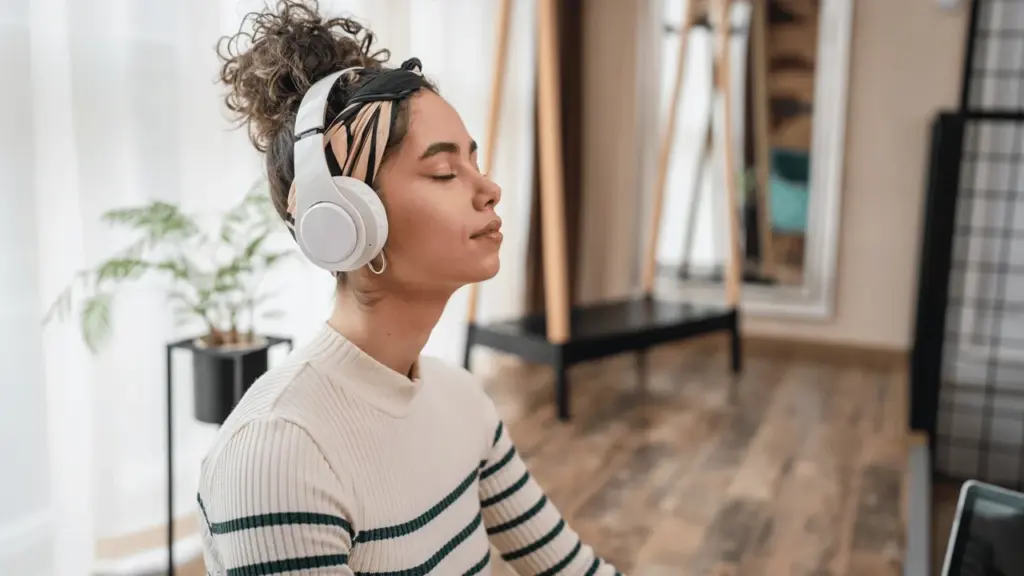
Put on your EEG headband and open the Attune app. Choose the Focus Protocol. Sit comfortably, spine upright, shoulders soft. Close your eyes. Direct your attention to the dark space behind your eyes. Listen for feedback: when a sound appears, your focus has slipped. Return to the visual field. Start with ten-minute sessions and gradually build up. The more you practise, the more natural the focus becomes.
Common Beginner Mistakes
Three traps catch most beginners. First, trying to “see” something specific colours, shapes, mandalas. That turns concentration meditation into visualisation, which is a different practice. Second, becoming frustrated when audio cues appear frequently. The cues are the workout. If you never hear them, you are not training. Third, treating the visual field as static. It is not it flickers, shifts, breathes. Let it. Your job is to keep contact, not to freeze the picture.
There is also a fourth, more subtle trap: tightening the eye muscles in an effort to “focus harder” on the visual field. The eyeballs should stay relaxed under closed lids. Squeezing them or rolling them upward creates physical tension that the brain interprets as effortful seeing, and the EEG signal becomes noisier. CEVAM works best when the body is genuinely still soft eyes, soft jaw, soft shoulders and the only thing doing the work is the directed attention itself.
What Progress Looks Like Week by Week
Concentration meditation tends to follow a predictable arc for new practitioners. Week one is usually busy audio cues appear frequently because the visual field is unfamiliar and attention slips easily. Most people catch about ten to fifteen drifts in a ten-minute session. This is normal and good. The catches are the training.
Week two often brings a small frustration plateau. The novelty has worn off and progress feels invisible. Push through it this is precisely when the underlying attentional system is being rewired. Week three usually rewards the persistence: cues become less frequent, the visual field starts to feel like a place rather than a void, and returns happen faster. By week four most users report a felt difference outside the session too they catch themselves drifting in conversations and in work, and the catch is quicker than it used to be.
How CEVAM Compares to Breath-Focused Meditation
Breath meditation is the default in most traditions, and it works. But the breath is a narrow, repetitive object, and many beginners find their mind wanders into hyperventilating, over-controlling the breath, or judging whether they are “doing it right.” Concentration meditation on the visual field sidesteps that. The field is broader, less prone to control, and critically produces a strong EEG signal that can be read in real time. You get feedback the breath cannot give you.
This does not mean breath meditation is wrong. Many practitioners alternate concentration meditation with CEVAM in the morning when EEG feedback is most useful, and a simpler breath-based practice in the evening or during travel when the headband is not at hand. The two reinforce each other: the attention skill built with one transfers cleanly to the other, and the variety keeps the practice from feeling mechanical. The right tool depends on what you have and what you are training, not on which tradition the technique came from.
The Takeaway
Concentration meditation with CEVAM is meditation you can measure, attention you can train. If you have struggled with breath-focused practices, or you are curious about what is actually happening in your brain when you meditate, give CEVAM a try. Your mind has a visual field. Learn to focus on it. Start with CEVAM in Attune, or read more on the Attune FAQ.
Frequently Asked Questions
Is concentration meditation safe for beginners?
Yes. CEVAM is a gentle attention practice with no breath manipulation or unusual physical positions. The only thing to do is sit comfortably and direct attention to the dark space behind your eyes. There are no risks beyond mild restlessness, which is normal in the first few sessions.
How is concentration meditation different from visualisation?
Visualisation asks you to generate a specific image a beach, a healing light, an object. Concentration meditation asks the opposite: do not generate anything, just rest your attention on what is already there in the dark visual field. The difference shows up clearly on EEG: visualisation patterns look different from CEVAM patterns.
How long until I see results with concentration meditation?
Most people notice a clear shift in catch speed within the first week of daily ten-minute sessions. The deeper shift a felt sense of stable attention you can call on outside the session usually appears around week three to four. With Attune’s real-time feedback, progress is visible session by session rather than guessed at.