What a Meditation Headband Actually Does Differently
There is no shortage of meditation apps. You have probably tried one soothing voice, calming music, guided sessions, a timer. They are useful. They are also, technically speaking, blind. A traditional meditation app cannot tell whether you are focused or daydreaming, and it cannot tell you either. A meditation headband paired with the right app can do both, and that single difference changes what your practice can actually become.

Most Apps Talk to You. A Meditation Headband Listens.
Traditional meditation apps are based on passive instruction. A calm voice tells you when to breathe in, breathe out, or come back to the breath when you drift. That is helpful, but it is a guessing game. You might be deeply focused or completely zoned out the app treats both states the same. It cannot tell what is happening inside your head.
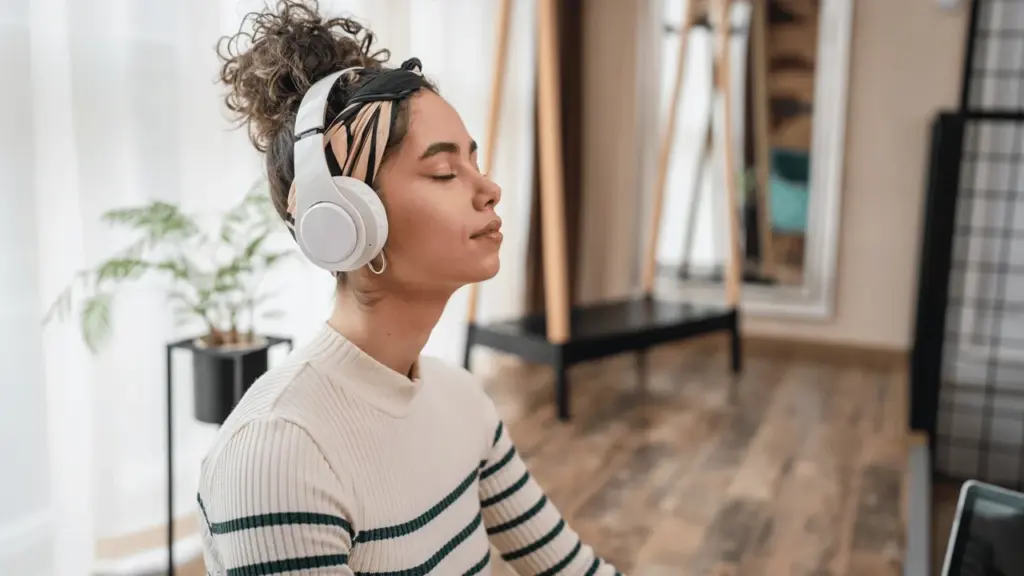
A meditation headband can. By using real-time brainwave monitoring with the BrainBit EEG headband, Attune knows when your attention drifts and gives you an immediate audio cue so you can bring it back. It is the difference between listening to a workout podcast and having a personal trainer watching your form.
Subjective Versus Objective Feedback
Traditional apps rely on self-reporting. How focused did you feel? Was your mind wandering a lot? Be honest: how do you really know? The mind is notoriously bad at judging its own state in the moment. Even experienced meditators routinely overestimate how much of a session they spent in focused attention versus mind-wandering.
A meditation headband removes the guesswork by giving you objective data. Using changes in alpha brainwave activity in the occipital cortex, Attune knows when you are focused and when you are not. You receive auditory feedback the moment your attention slips, and you correct course in real time.
Two Modes, One Meditation Headband
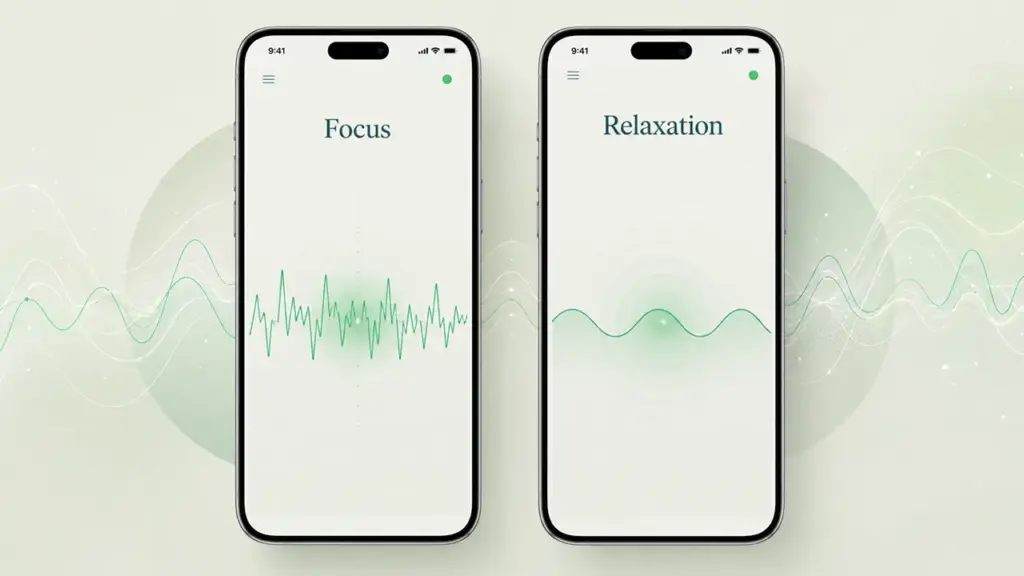
Another difference: Attune adapts to your goal. Two protocols run on the same hardware, and the same alpha signal is interpreted in opposite directions. Most meditation apps do one thing guided relaxation. A meditation headband paired with Attune does both, on the same headband, and the choice is yours every time you open the app.
Focus Protocol: How a Meditation Headband Trains Attention
The Focus Protocol uses Closed-Eyes Visual Attention Meditation (CEVAM). It rewards decreased occipital alpha the neural signal of sustained mental focus on the inner visual field. When you drift, alpha rises and you hear a gentle cue. You return. Rep complete. Over weeks, the speed of your catches measurably improves.
Relaxation Protocol
The Relaxation Protocol does the opposite. It rewards increased alpha the neural signal of relaxed disengagement. As your brain lets go, the app responds with reinforcing audio. You can finally tell the difference between “sitting there hoping to relax” and actually doing it.
What a Session Actually Looks Like
A typical session with a meditation headband like the BrainBit + Attune runs ten to twenty minutes. You put on the headband dry electrodes, no gel, takes about thirty seconds to position. You open the app and pick a protocol. The first sixty seconds are calibration: the app records your eyes-open and eyes-closed baseline alpha. This is important because alpha varies a lot from person to person and even day to day. Comparing your live signal to your own baseline is what makes the feedback meaningful.
After calibration, the actual session starts. You close your eyes and direct attention to the dark visual field for the Focus Protocol, or simply let go for the Relaxation Protocol. Audio cues appear based on your real-time alpha. At the end you see session analytics how long you sustained focus, how often you drifted, how your performance compares to previous sessions.
A Practice That Evolves With You
Traditional meditation apps tend to plateau. After the first ten or twenty sessions, the format starts to repeat. The same voice, the same script, the same vague affirmation that you are doing well. You might feel calmer, but it is hard to know whether you are actually getting better at meditating.
A meditation headband is different. Because the Attune app reads your actual brainwaves every session, each session reflects your current mental state. The feedback adapts to where you are today, not where you were last week. As your focus improves, the difficulty implicitly rises with you the same level of audio cueing now corresponds to a smaller drift, because your baseline has shifted.
Setup, Comfort, and Daily Use
A common worry about a meditation headband is that it will be fiddly or uncomfortable. In practice the BrainBit is small, wireless, and uses dry electrodes no gel, no pads, no skin prep. Most users get setup down to under a minute after the first few sessions. The headband sits across the back of the head where the occipital sensors need to be, and the rest of the day you keep it on a small stand near your meditation spot so reaching for it does not add friction.
Who a Meditation Headband Is For
If you want a soothing voice to fall asleep to, there are plenty of apps for that. A meditation headband is for a different audience: people who want to train attention as a measurable skill, people frustrated with traditional meditation because they cannot tell whether it is working, neuroscience-curious users who want to see what their brain is actually doing, and people with high cognitive demand knowledge workers, students, creatives who treat focus as a professional skill worth investing in.
It is also a useful tool for experienced meditators who have plateaued. Years of practice can build a stable surface that hides what the underlying attention is doing. A meditation headband exposes that surface: the live alpha signal makes it obvious where genuine focus ends and well-rehearsed stillness begins. Many long-time practitioners describe their first few Attune sessions as humbling in a useful way proof that there is still attentional territory to train, even after a decade on the cushion.
The Takeaway
Most meditation apps are playlists with a clock. A meditation headband is a precision tool for mental clarity, backed by neuroscience and grounded in your own real-time brain data. If you are ready to stop guessing and start training, try Attune today. More on the approach in the Attune FAQ.
Frequently Asked Questions
What is a meditation headband?
It is a wearable device that reads your brain activity in real time usually via EEG and uses that signal to give you immediate feedback during a meditation session. The feedback closes the loop between intention and outcome, so you know whether your attention is where you wanted it to be.
Does a meditation headband really work?
Yes, when the feedback is well-designed and the protocol is grounded in real neuroscience. Attune uses occipital alpha as its core signal, which has decades of research behind it as a marker of attentional state. Most users see a measurable shift in catch speed within two weeks of daily ten-to-fifteen-minute sessions.
What do I need to use Attune?
The Attune app and the BrainBit EEG meditation headband. The headband is wireless, dry-electrode (no gel), and connects by Bluetooth. Setup takes a couple of minutes. After that, you open the app, choose your protocol (focus or relaxation), and start the session.