Why Meditation Posture Is Not the One That Feels Most Relaxed
If you are looking for the right meditation posture, the first thing to know is that the most comfortable position is rarely the most effective one. Lying down feels good. It also tilts your brain toward sleep within minutes, and sustained attention becomes almost impossible. Posture is not aesthetic. It is a direct input to your nervous system, and the right one makes focused attention easier sometimes by a surprising amount.
Why Meditation Posture Affects the Mind
When you sit upright with a straight but relaxed spine, your nervous system gets subtle signals of wakefulness and readiness. Mechanoreceptors in your back and neck stay lightly engaged. Breathing is fuller. Your brain stays in a state of alert calm rather than sliding toward sleep. The technical result: alpha activity does not drift unchecked toward the high values associated with drowsiness.
Lying down does the opposite. The body interprets horizontal as an invitation to sleep. Alpha and even theta activity rise, the visual cortex disengages, and sustaining focused attention requires significantly more effort than it would sitting up. This is not a willpower problem. The brain has billions of years of cuing telling it that horizontal means rest.
Two Goals, Two Meditation Postures
Posture should match what you are training. For the Focus Protocol, you are training executive control over attention. That requires a balance of relaxation and alertness best supported by an upright sit. For the Relaxation Protocol, the goal flips. Here, rising alpha is rewarded and full letting go is encouraged. Lying down is fine even useful because the body can fully release tension.
The Best Meditation Posture for Focus Sessions
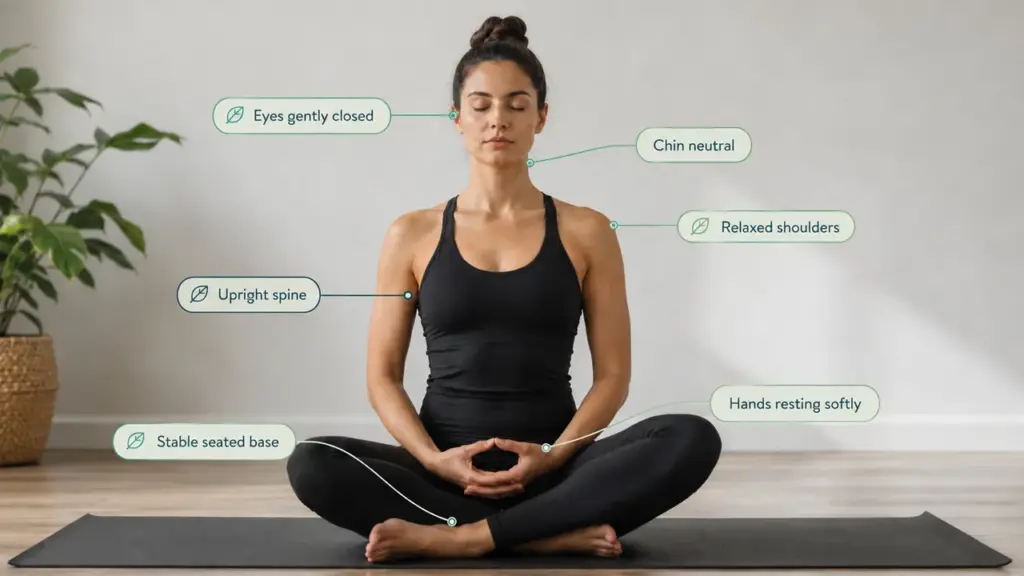
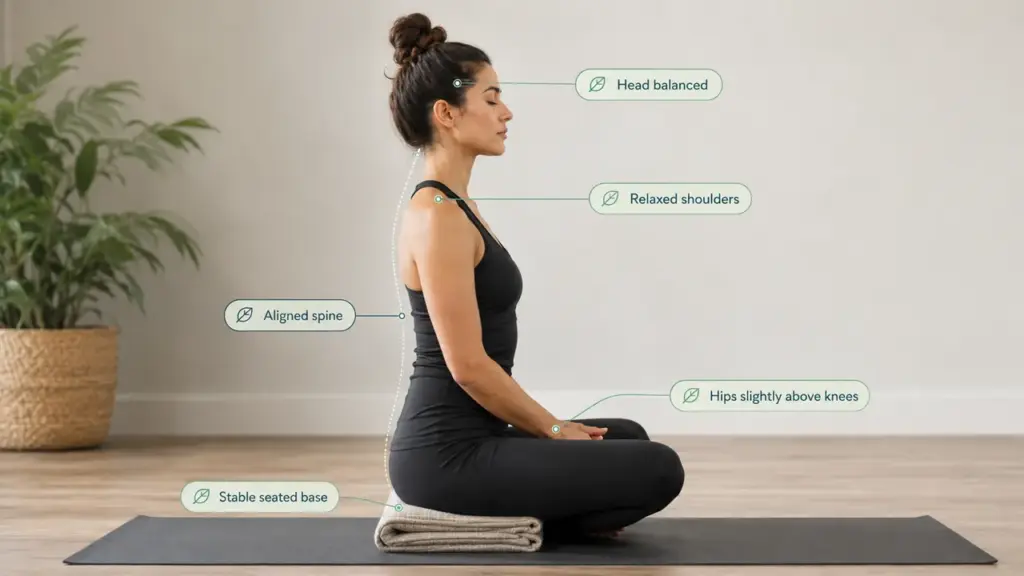
An upright sit means a few specific things. Spine stacked rather than slumped. Hips slightly above knees if possible a cushion or folded blanket under the sit bones does this for most people. Shoulders soft, not pulled back, not rolled forward. Head balanced lightly over the spine rather than tilted forward to look at your lap. Chair is fine if the floor does not work. The brain does not care about the surface; it cares about the spinal angle and the alertness signal that comes with it.
Common Posture Mistakes That Sabotage Focus
The most common mistake is sitting back into a couch or against a chair back. The spine loses its lift, the head tilts down, drowsiness arrives. Second mistake: forcing the spine ramrod straight with muscular effort. That creates tension that pulls attention to the body and away from the practice. The spine should be tall but soft. Third: meditating right after a heavy meal. Even with perfect posture, digestion will pull alpha upward and make focus harder. Fourth: trying to maintain a complex traditional posture full lotus, for instance before the hips are ready. The pain becomes the focus and the practice becomes endurance.
A fifth mistake is using a meditation cushion that is the wrong height for your hips. If your knees end up above your hips, the lower back rounds backward and the spine collapses within a few minutes. If the cushion is too tall, the hips tilt forward and the lower back arches into a strained position. The best meditation posture for focus is one where the hips sit slightly higher than the knees, with no muscular effort holding the spine in place. A folded blanket beneath a cushion is often a better solution than buying a new prop.
Breathing, Eye Position, and Hand Placement
Meditation posture is more than spinal angle. Three smaller details often make the difference between a session that holds focus and one that fights for it. Breathing: keep it natural and through the nose. Do not deepen or slow it deliberately during focus training that shifts attention onto the breath and away from the visual field you are trying to attend to. Let the body breathe itself.
Eye position: eyes closed for both protocols, but with the eyeballs relaxed rather than actively looking down or up under the lids. Active eye effort tightens the visual cortex in a way that interferes with the alpha signal Attune is reading. Hand placement: rest your hands somewhere stable thighs, knees, or one on top of the other in your lap. The specific position matters less than the stillness. Hands that wander are a small but consistent attention drain. Stable hands quietly reinforce the rest of the posture.
How Attune Makes Posture Visible
Attune’s EEG feedback makes the effect of meditation posture quietly obvious. If you lie down during a focus session, you will hear more feedback because alpha rises. Sit up, and the audio quiets your brain has shifted into the attentive state the Attune app is training. Most people who use the app figure out their personal best meditation posture within a few sessions, just by listening to where their alpha goes.
The Body Tells the Brain More Than You Think
There is a tendency to treat the body as a vehicle that delivers the mind to the cushion. Meditation posture is not a delivery problem; it is a signal. Sitting upright with a stable, relaxed spine is a direct message to the nervous system: we are awake, we are present, we are doing something on purpose. That message produces a brain state that supports focused attention. Lying down sends the opposite message and gets the opposite brain state. Neither is wrong they suit different goals.
Choose your posture based on your goal. Sit upright to train focus. Lie down to train relaxation. Your brain responds to the body more than you might think, and the best meditation posture is the one that quietly tells your nervous system it is time to work.
The Takeaway
Meditation posture is not a side detail it is a direct input to the brain state you are trying to train. For focus, sit. For relaxation, lie down. Match the posture to the protocol and your sessions get measurably easier. Try a session with Attune and feel the difference yourself. More on the protocols in the Attune FAQ.
Frequently Asked Questions
What is the best meditation posture for beginners?
A chair. Sit toward the front of the seat, feet flat on the floor, spine tall but relaxed, hands resting on your thighs. You do not need to sit cross-legged on the floor to train focus. The chair gives you the alertness signal without the discomfort that would otherwise dominate your attention.
Can I meditate lying down?
You can, but for focus training it is significantly harder. Alpha activity rises quickly in a horizontal position and sustained attention becomes a fight against drowsiness. Lying down is ideal for relaxation protocols and short body-scan practices, where letting go is the goal.
Does the lotus position make meditation better?
Not inherently. Lotus is a stable platform if your hips are open enough for it to be comfortable, but the brain does not care about the leg position it cares about the spinal angle and the alertness signal. A simple chair sit with good spinal alignment trains focus just as well as any traditional posture.